
Weapons and Firing Modes: Read the Current Stats
The current Nebula Assault Rifle card is a useful reading model; it is not a complete weapon list or DPS tier chart.
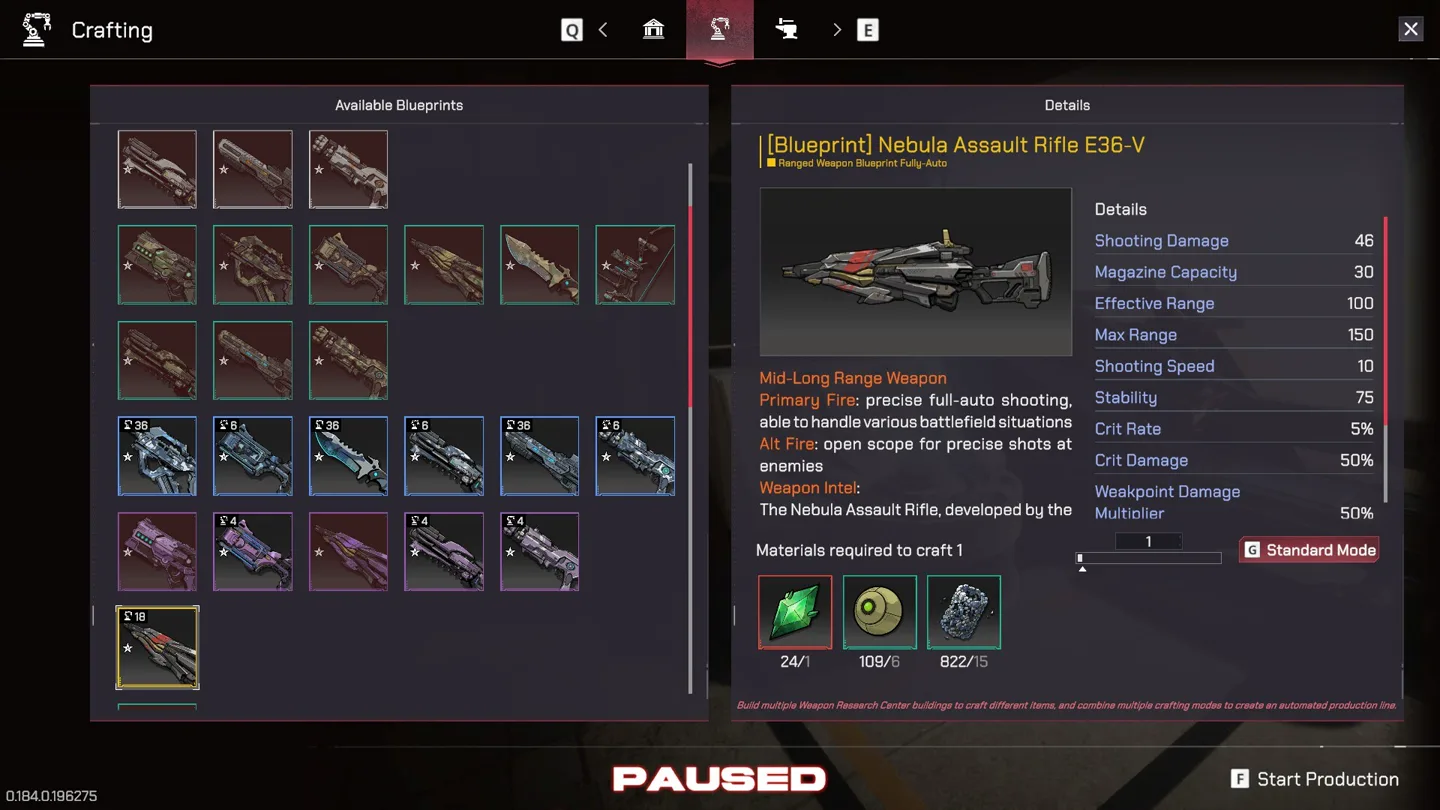
Table of contents
Weapon cards combine behavior and numbers. Read the behavior first. A high damage value can still be a bad fit when range, magazine, stability, alternate fire, or encounter geometry contradict the plan.
The seven-field weapon read
- Primary fire: What happens when you hold or press the main trigger?
- Alternate fire: Does it change aim, scope, projectile, charge, or mode?
- Damage and speed: How much per event, and how often?
- Magazine: How long can the weapon sustain pressure before reloading?
- Effective and maximum range: Where does the weapon want the fight to happen?
- Stability: How much effort is required to keep repeated fire on target?
- Critical and weak-point values: What reward comes from accuracy and target knowledge?
Do not collapse those fields into a single “DPS” answer unless you can reproduce the fire cycle, reload, range, target defense, critical rate, weak-point access, and Core effects.
Current readable example: Nebula Assault Rifle E36-V
The current crafting card identifies [Blueprint] Nebula Assault Rifle E36-V as a ranged, fully automatic weapon.
| Field | Current readable value |
|---|---|
| Primary | Precise full-auto fire |
| Alternate | Open scope |
| Shooting damage | 46 |
| Magazine | 30 |
| Effective range | 100 |
| Maximum range | 150 |
| Shooting speed | 10 |
| Stability | 75 |
| Critical chance | 5% |
| Critical damage | 50% |
| Weak-point multiplier | 50% |
This card describes one current weapon. It is not evidence that the weapon is best, nor that every named weapon from pre-unlock updates retains the same numbers.
Primary and alternate fire as roles
For the Nebula Assault Rifle, full-auto primary fire supports sustained pressure while the scoped alternate action supports deliberate aiming. That pairing creates a decision:
- Use unscoped or normal full-auto when movement and target switching dominate.
- Use the scope when distance, weak points, or precision can pay for reduced awareness and movement flexibility.
- Leave the scope when projectile pressure or a close threat makes tunnel vision expensive.
The “better” mode changes during the same encounter.
Match a weapon to encounter geometry
| Encounter signal | Weapon question |
|---|---|
| Open space and visible weak points | Can effective range and stability exploit it? |
| Dense projectiles | Can you maintain awareness while aiming? |
| Fast close targets | Is magazine and handling more important than maximum range? |
| Large armored target | Can the squad reach weak points and sustain fire safely? |
| Capture attempt | Can ordinary damage be controlled after weakening the target? |
Other current names, without invented rows
Recent official change material names weapons including Gratov Quantum Longbow, Bioplasma Shotgun, and Bowblaster. This page does not attach current stats or rankings to those names because the present readable cards are not available here.
Add Cores after understanding the weapon
A Core effect has triggers, range, uptime, and exceptions. Evaluate it against the real fire pattern:
- A close retaliation effect may not suit a plan built around distance.
- A Drone trigger needs enough Drone activity to matter.
- Control text must be checked for boss or Overlord immunity.
- A temporary summon should align with the weapon’s damage window.
Use Weapon Cores for the terminology and the Core Combination Planner for the small current Core sample.
Field test without pretending it is a tier list
Test one weapon against one repeatable task:
- Name the target type and range.
- Use the same squad and Core context.
- Record magazine use, reload exposure, accuracy problems, and weak-point access.
- Note which firing mode solved which phase.
- Change one variable for the next test.
That produces a decision you can reuse. A ranking without context produces a headline.
Related guides
Weapon Cores and Core Fragments: Roles and Terminology
Understand the current Core choice, collection, tag, and combination vocabulary without claiming a full catalogue.
Read guideSoldiers and Squad Roles: Work, Status, and Field Commands
Use work attributes, assignment, status, follow commands, and aging as separate decisions.
Read guideEnemies, Elites, and Sector Overlords: Read the Threat
Recognize large threats, weak points, projectiles, mines, and immunity warnings without inventing an all-boss list.
Read guide