
Jobs and Production: Diagnose the Bottleneck
When a line stalls, check material availability, hauling, storage, staffing, and output capacity in that order.
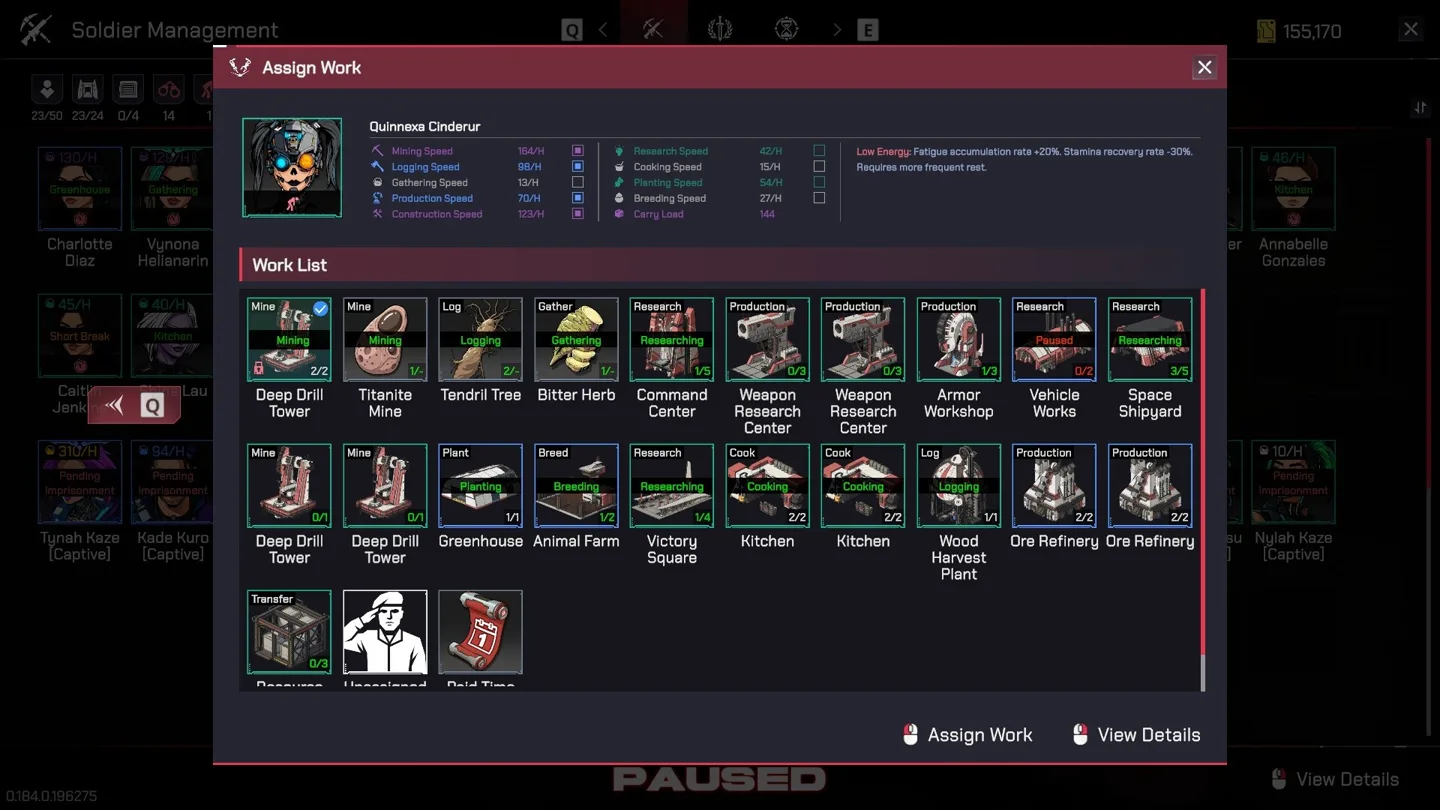
Table of contents
When production stops, the visible idle worker is often the last link in the failure—not the first. Diagnose the chain in this order:
input → delivery → storage → worker → process → output space
Adding workers before checking the earlier links can make the colony slower by creating more travel and consumption without moving more material.
The current work attributes
The current assignment view separates nine work attributes:
| Attribute | Use it to evaluate | Common mistake |
|---|---|---|
| Mining | Ore and mining work | Ignoring hauling from the site |
| Logging | Wood extraction | Building processors before supply is stable |
| Gathering | Wild or field collection | Treating it as the same job as planting |
| Production | Conversion and workshop work | Blaming production when inputs are absent |
| Construction | Completing placed structures | Assigning everyone away after placement |
| Research | Generating research output | Queuing nodes without a capability goal |
| Cooking | Food processing | Letting output or ingredient storage fill |
| Planting | Crop work | Forgetting the rest of the food chain |
| Breeding | Animal work | Expanding before food and staffing are ready |
Carry load is also visible and deserves its own operational check. A high-output workstation can still starve when material cannot reach it or its products cannot leave.
The six-check bottleneck flow
1. Input exists
Confirm the source is producing the right material. A resource icon at the destination does not prove fresh input is arriving.
2. Delivery can happen
Check distance, route access, available carriers, carry capacity, and any transport building involved. Resource Transport Station behavior and hauling are especially important in longer chains.
3. Storage has room
Inspect both input and output storage. A full output store can stop a building that looks fully supplied.
4. A suitable worker is assigned
Match aptitude to the actual job, not the building’s visual theme. Also check whether the worker has been redirected, aged, or otherwise changed.
5. The production rule requests work
The late pre-unlock production model documented three modes after the warehouse capability:
- Order: request a fixed amount.
- Stock: maintain a target reserve.
- Auto: continue according to the automatic rule.
Read the current mode and target before declaring the line broken; exact unlock and behavior remain patch-sensitive.
6. Output can leave
Confirm the product has destination capacity and someone can move it. The largest number of producers is useless if the line is blocked at its end.
Match buildings to the full chain
The current job screen visibly includes a wide range of work sites: Deep Drill Tower, Titanite Mine, Tendril Tree, Bitter Herb, Command Center, Weapon Research Center, Armor Workshop, Vehicle Works, Space Shipyard, Greenhouse, Animal Farm, Victory Square, Kitchen, Wood Harvest Plant, Ore Refinery, and a transport entry whose full name is cut off in the current image.
That list is a readable sample, not a complete building database. It is enough to show why the colony needs extraction, conversion, research, food, government, transport, and specialist work at the same time.
Production modes by player intent
Choose the mode from the decision you need:
| Intent | Better starting mode | Watch for |
|---|---|---|
| Craft a known one-time quantity | Order | Inputs reserved by another line |
| Keep a safety buffer | Stock | Target larger than storage or consumption needs |
| Run a mature, balanced line | Auto | Silent overproduction or transport congestion |
Do not set every line to automatic immediately. Automatic production is easiest to read after you know normal input rate, consumption, storage, and hauling.
A safe expansion rule
Add the next building only when the present line can answer all five:
- What input limits it?
- Which worker attribute operates it?
- Who or what moves input and output?
- Where is each side stored?
- Which downstream task consumes the output?
If any answer is missing, improve observation or layout before adding capacity. For named production relationships and the readable weapon crafting example, use Resources and Recipes.
Related guides
Buildings and Layout: Functional Colony Zoning
Place work, storage, housing, and transport by flow and access instead of copying an “optimal” grid.
Read guideResources and Recipes: Current Production Reference
A bounded index of readable buildings and one current weapon recipe, plus a method for tracing unknown materials.
Read guideCitizens: Fear, Loyalty, Relationships, and Rebellion
Read citizen signals, isolate the cause of unrest, and choose a government or production response.
Read guide