
Weapon Cores and Core Fragments: Roles and Terminology
Read a Core as an effect package with tags and conditions, then test whether it supports the weapon and encounter you are actually using.
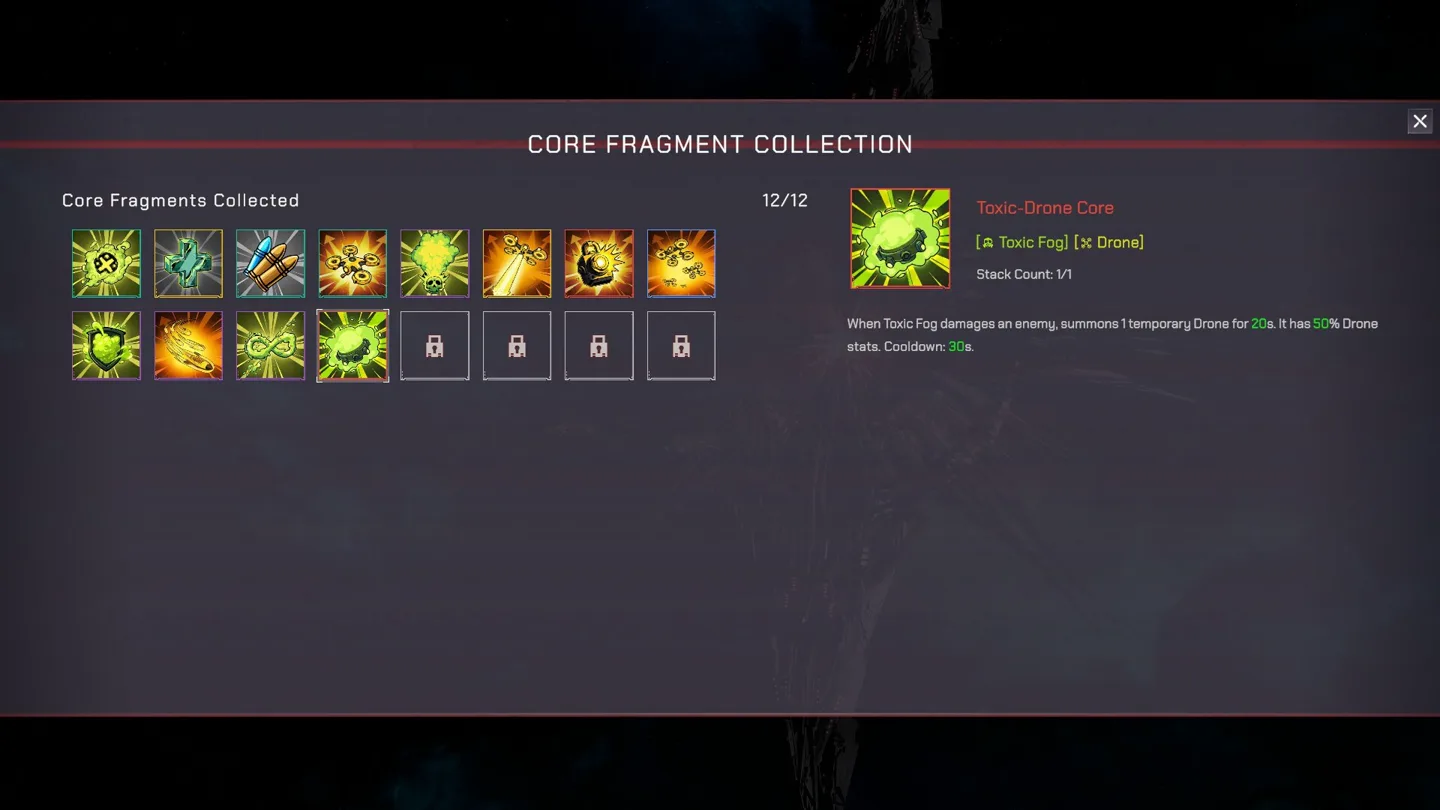
Table of contents
Pax Autocratica uses “Cores” and “Core Fragments” across choices and collection views. Treat the terminology carefully: a Fragment can be part of discovery or collection, while the selected Core card describes an effect package used in a build. The exact acquisition and persistence rules should be read from the current screen.
Read a Core as a rule
Every useful Core description can be reduced to:
trigger → condition → effect → target → window → exception
For example, a defensive Core can trigger on damage, require a stored guard, reduce the hit, retaliate within a radius, and then consume its stack. Leaving out any one part can turn a situational effect into a misleading “best Core.”
Current readable sample
Retaliation Core
- Gains one Retaliation Guard every 10 seconds, capped at one stack.
- On damage, consumes the guard and reduces that damage by 25%.
- Retaliates within 4 m for 400 plus 200% weapon DPS.
This is a timed close-defense package. Its value depends on incoming hit timing and whether the attacker is within the stated radius.
Drone EMP
- Drone EMP bombs deal 300 damage.
- They disable elite or boss abilities for 8 seconds.
- The displayed cooldown is 15 seconds.
- Sector Overlords are immune.
The immunity is decisive. Do not bring a control plan to an Overlord encounter if the card says the target ignores it.
Toxic-Drone Core
- Displays the Toxic Fog and Drone tags.
- Toxic Fog damage summons a temporary Drone for 20 seconds.
- The Drone has 50% of drone stats.
- The displayed cooldown is 30 seconds.
This is the one readable relationship exposed in the current planner sample.
Choice screen versus collection screen
The choice screen answers “Which effect should I take now?” The collection screen answers “What has been discovered in this collection view?” Keep those questions separate.
The current collection image displays 12/12. Do not generalize that number to every sector, build, or future edition. Use it as a recognition point for the shown collection state.
Choose a Core in four passes
- Encounter: elite, boss, Overlord, swarm, range, and space-control needs.
- Weapon: firing mode, uptime, range, and weak-point behavior.
- Trigger reliability: how often your build actually satisfies the condition.
- Exception: immunity, cooldown, stack cap, radius, or duration that limits payoff.
Then compare the Core with the next-best choice. A dramatic effect that rarely triggers may provide less value than a modest one aligned with every magazine.
Combination vocabulary
The current Toxic-Drone card visibly joins Toxic Fog and Drone. The Core Combination Planner can resolve that pair and search the three readable records. Other pairs return unknown by design. Expand the table from current cards, not from similar icons or older combination lists.
Questions still open
The launch sample does not establish:
- the complete Core and Fragment catalogue;
- every pair or multi-part combination;
- full acquisition and persistence rules;
- current rarity distribution and all unlock levels;
- a reproducible “strongest” combination across weapons and sectors.
For the weapon half of the build, continue to Weapons and Firing Modes. For the environment that tests the build, use Expeditions and Sectors.
Related guides
Core Combination Planner and Current Core Sample
Search three readable current Core records and test the one combination relationship visible in current material.
Read guideWeapons and Firing Modes: Read the Current Stats
Interpret primary and alternate fire, range, stability, magazine, critical, and weak-point values.
Read guideExpeditions and Sectors: Prepare, Read, Return
Use expedition progress, enemy strength, Core collection, supplies, and colony risk to make the return decision.
Read guide